Active Presence
Collaboration under uncertainty. Psychological safety in real work conditions.
For Department Heads, Management and People Leaders
The Challenge
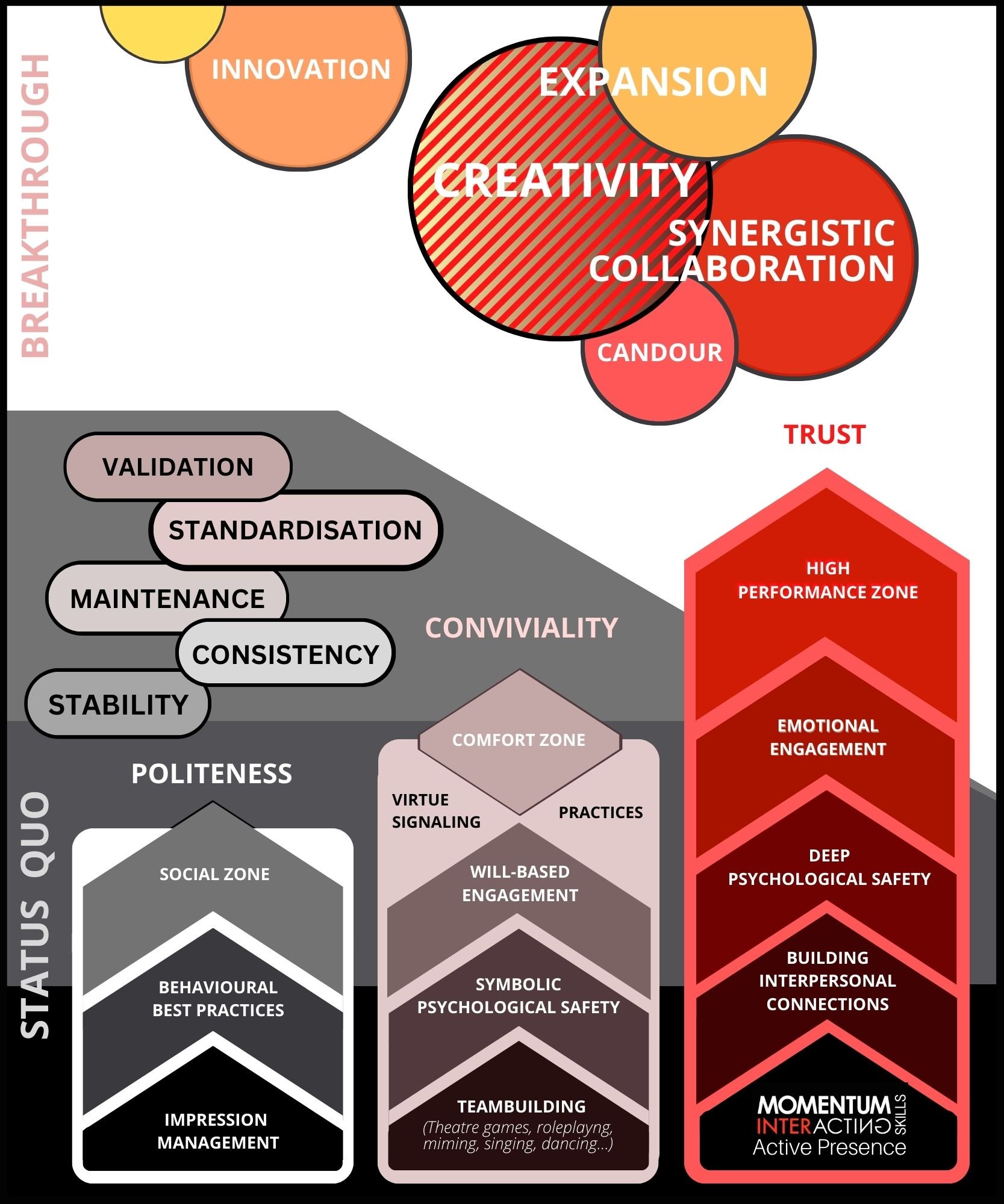
In complex, fast‑moving organisations, performance is rarely limited by technical competence. It is limited by what happens between people when outcomes are uncertain, stakes are high, and collaboration cannot be reduced to scripts or procedures.
Teams often appear functional on the surface while avoiding the very interactions that would surface risk, innovation, disagreement, or truth. People self‑protect. They manage impressions. They hesitate to speak, to challenge, or to expose incomplete thinking. Over time, this erodes trust, slows decision‑making, and constrains creative capacity.
What is missing is not knowledge or motivation. It is behavioural presence — the capacity to stay engaged, open, and responsive in real‑time interaction when pressure, uncertainty, or vulnerability increase.
The Solution
Active Presence is a one‑day, in‑person experiential training designed to develop collaboration, psychological safety, and performance under uncertainty.
The work adapts tools originally developed for professional actor training — not as theatrical exercises, but as interaction‑skills training — to help professionals build behavioural clarity, decision quality, and collaborative resilience in real work conditions.
Participants learn through structured behavioural exercises and real‑time feedback how attention, vulnerability, and behavioural presence shape outcomes in live interaction. Rather than relying on conceptual models or scripted techniques, the methodology centres on observable cause and effect: how small shifts in presence materially alter trust, engagement, and collaborative effectiveness.
There is no role‑play, no theatre games, no singing, and no performative exercises.
What Participants Develop
Through a structured progression of group and one‑on‑one exercises, participants develop the capacity to:
Stay behaviourally present and responsive under pressure.
Engage with vulnerability constructively to strengthen trust.
Reduce self‑protection and impression management in interaction.
Increase candour without escalating interpersonal risk.
Collaborate effectively when outcomes are not yet known.
Notice and adjust behavioural interference that distorts communication.
Sustain creative engagement in high‑stakes situations.
The emphasis is not on techniques to perform, but on capacities to embody.
A Case for Psychological Safety
Google’s Project Aristotle, an extensive study on team effectiveness, concluded that ‘psychological safety’ is the most important trait of high-performing teams. Harvard’s Amy Edmondson, a pioneer in psychological safety, defines it as an environment where team members feel safe to take interpersonal risks and be vulnerable in front of each other. In these settings, team members feel able to ask questions, share ideas, admit mistakes, challenge assumptions, contribute incomplete or emerging ideas, and address challenges openly.
But psychological safety is not created by policies, verbal formulas, or behavioural prescriptions. It is created — or undermined — moment by moment through live interaction. Cultivating psychological safety and trust requires real engagement and the willingness to meet vulnerability constructively. Strategies like learned verbal formulas, practised body language, impression management, or personality profiling fall short when developing high-performance collaboration. As Professor Brené Brown notes, vulnerability is “the birthplace of innovation, creativity, and change.”
Active Presence trains the behavioural foundations of psychological safety: how people signal openness or withdrawal, how vulnerability is met or deflected, and how attention either invites or blocks real collaboration.
Why Professional Actors Offer Unique Insight into High-Performance Collaboration
Professional actors are trained to collaborate under unresolved outcomes, high performance pressure, and constant uncertainty. They must establish trust quickly, remain open to changing direction, and stay behaviourally responsive to partners in real time.
The value of actor training is not theatrical performance. It is interaction discipline.
Active Presence adapts these interaction‑skills tools to organisational contexts, providing a practical methodology for developing presence, vulnerability tolerance, and collaborative clarity in environments where stakes are high and scripts do not exist.
Format
One‑day, in‑person training
Designed for up to ten participants
Experiential methodology
Structured progression of behavioural exercises
Real‑time observation and feedback
The training is designed for leadership teams, management groups, and professionals working in high‑stakes, collaborative environments.